Table of contents
Introduction
English version of an article first published in Polish on 26 June 2026. Read the Polish original.
For the past two years everyone has been asking the same question: if AI summarises my content, how do I know whether it cites me at all? Bing has just given the first real answer. AI Performance in Bing Webmaster Tools shows how your content is cited in AI-generated answers, in concrete numbers rather than guesses.
Importantly, Bing not only launched this first (February 2026), but in June 2026 went a step further and added metrics nobody else has yet: Citation Share, Intents and Topics. Google has only joined in now, in June, with its own reports in Search Console. More on that in a moment.
Below I take a close look at the new reports: what exactly they show, why Citation Share changes how we think about visibility, and how to get value out of them even if you live mainly off Google.
You will learn:
- What AI Performance in Bing Webmaster Tools is and what exactly it measures
- What the new reports show: Intents, Topics, Citation Share and Compare
- Why Citation Share is the first real metric of your share of AI visibility
- How this differs from the reports Google has just added to Search Console
- How to use this data in practice (GEO/AEO), even if you work mainly with Google
- Why it is worth setting up a Bing Webmaster Tools account now
What AI Performance is
AI Performance is a set of reports in Bing Webmaster Tools that measures citations of your content in AI answers: in Microsoft Copilot, in AI summaries in Bing and at selected partners. It is a different layer from the classic performance report: instead of clicks from blue links, you look at how often AI takes your pages as a source, and which ones.
In the basic version (since February 2026) you will find, among other things:
- Total Citations: the number of citations in the selected period
- Average Cited Pages: how many unique pages per day appear as a source
- Grounding queries: the queries on the basis of which AI retrieved your content
- URL-level citations and trends over time
For the first time, "does AI cite me?" stops being a rhetorical question. You get a number, a date and a specific query.
New: Intents, Topics, Citation Share, Compare
On 16 June 2026 Bing expanded AI Performance with four things that turn these reports from a curiosity into a real strategic tool:
Intents
Classifies grounding queries into categories: informational, commercial, navigational, "learn and solve", research, creation, local and others. You see the context of the queries, not just the phrases.
Topics
Groups related queries into topic clusters, the way AI organises them. For example, "solar panels", "solar energy efficiency" and "PV installation" go into the topic "Solar energy".
Citation Share
The percentage of citations going to your site out of all sources for a given grounding query. Your share, not just "am I being cited".
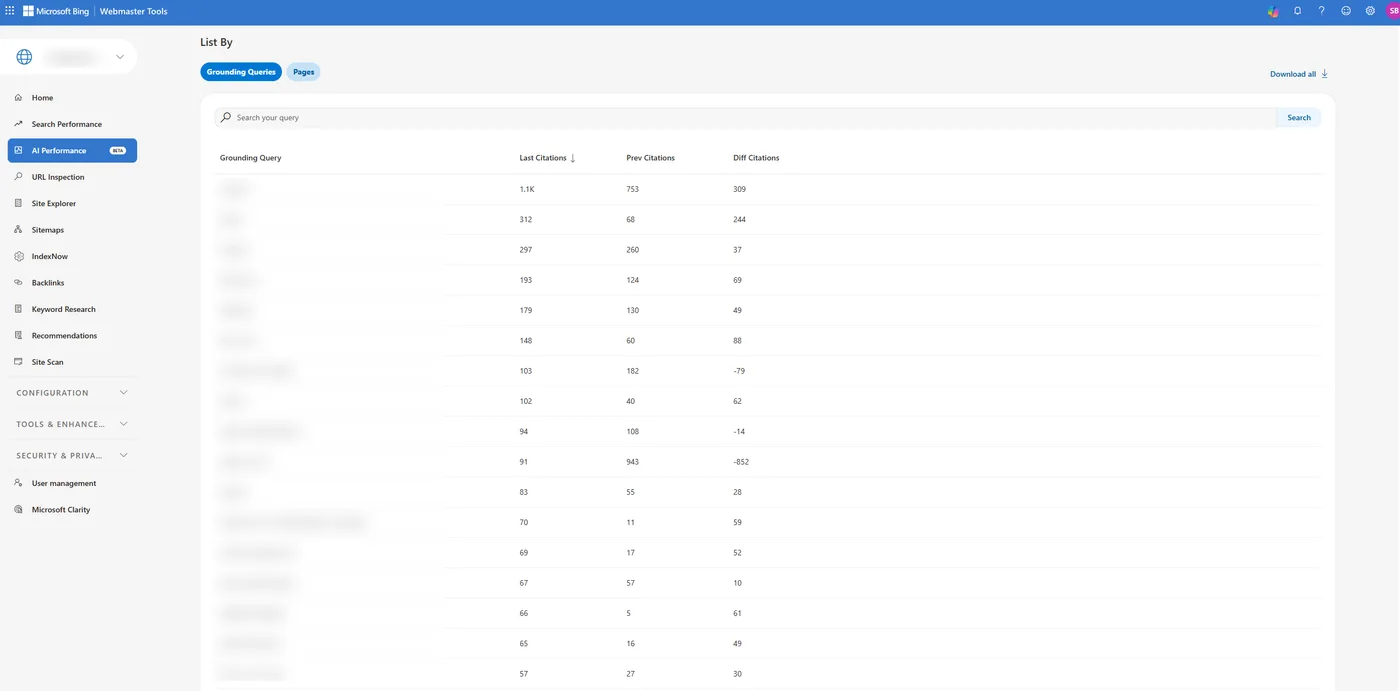
Compare
Overlays previous periods on the current one: you compare 30-day windows or your own date ranges and see what has changed.
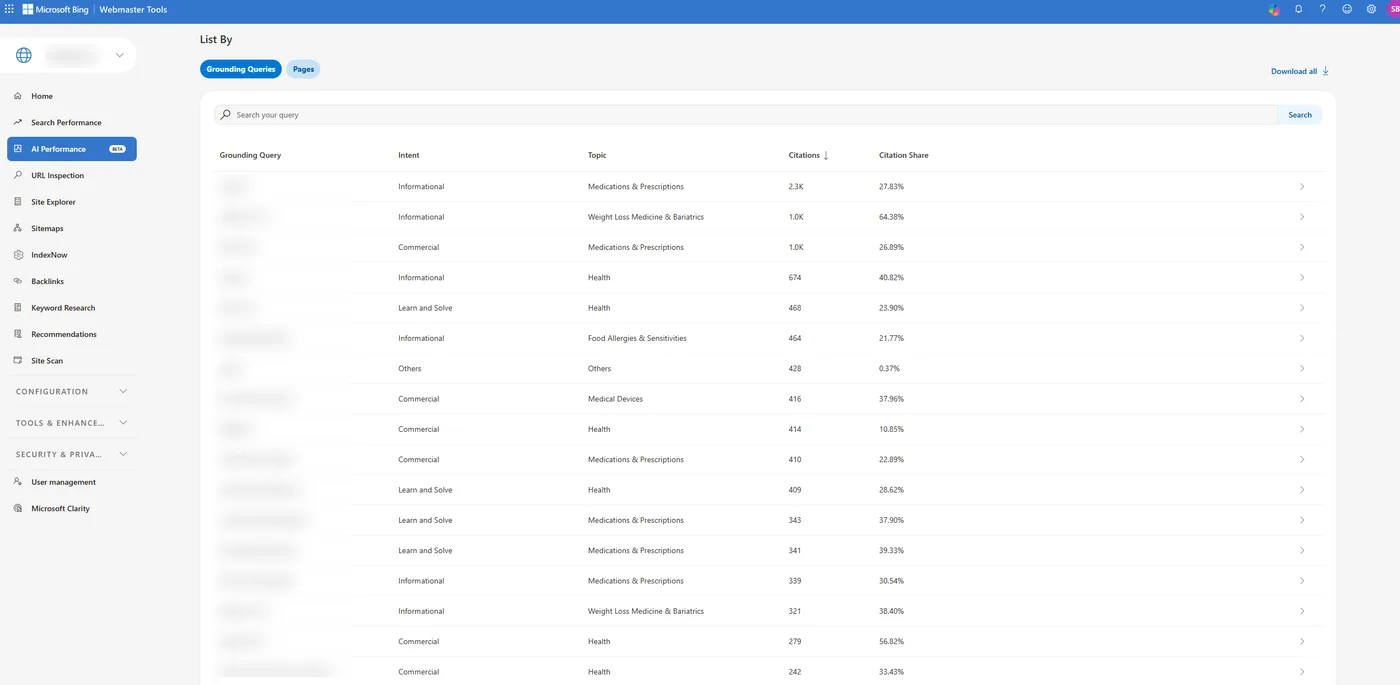
Citation Share, the most important metric
For me Citation Share is the most important of the new features, because it shifts the thinking from presence to competitiveness. "I was cited" says little on its own. The question is what share you have of the whole pool of cited sources for a given query. It is a bit like market share: 1 citation among 3 sources is a completely different situation from 1 among 30.
Citation Share is the first metric that tells you not "whether you exist in the AI answer" but "how much you count in it" relative to the competition.
Why this is a breakthrough
Until now, AI visibility was a black box. You could suspect that ChatGPT or Copilot were using your content, but you had no way of measuring it: no numbers, no trends, no point of reference. AI Performance turns that black box into an ordinary report.
It changes three things at once:
- From guesses to data: "they probably cite us" becomes a specific number and a trend
- From presence to share: Citation Share shows how you compare with the competition
- From phrases to intents and topics: Intents and Topics show in which areas you are building authority
This is the first real foundation for GEO/AEO (optimisation for generative engines), because you can only optimise what you can measure. I described how AI answers themselves work and how to compete for a citation in my article on AI Overviews.
What about Google
For a long time Google counted traffic from AI features quietly, inside the general performance report, without breaking it out. That changed in June 2026: Google announced generative AI performance reports in Search Console. So the direction is the same as at Bing: more transparency about how AI uses your content.
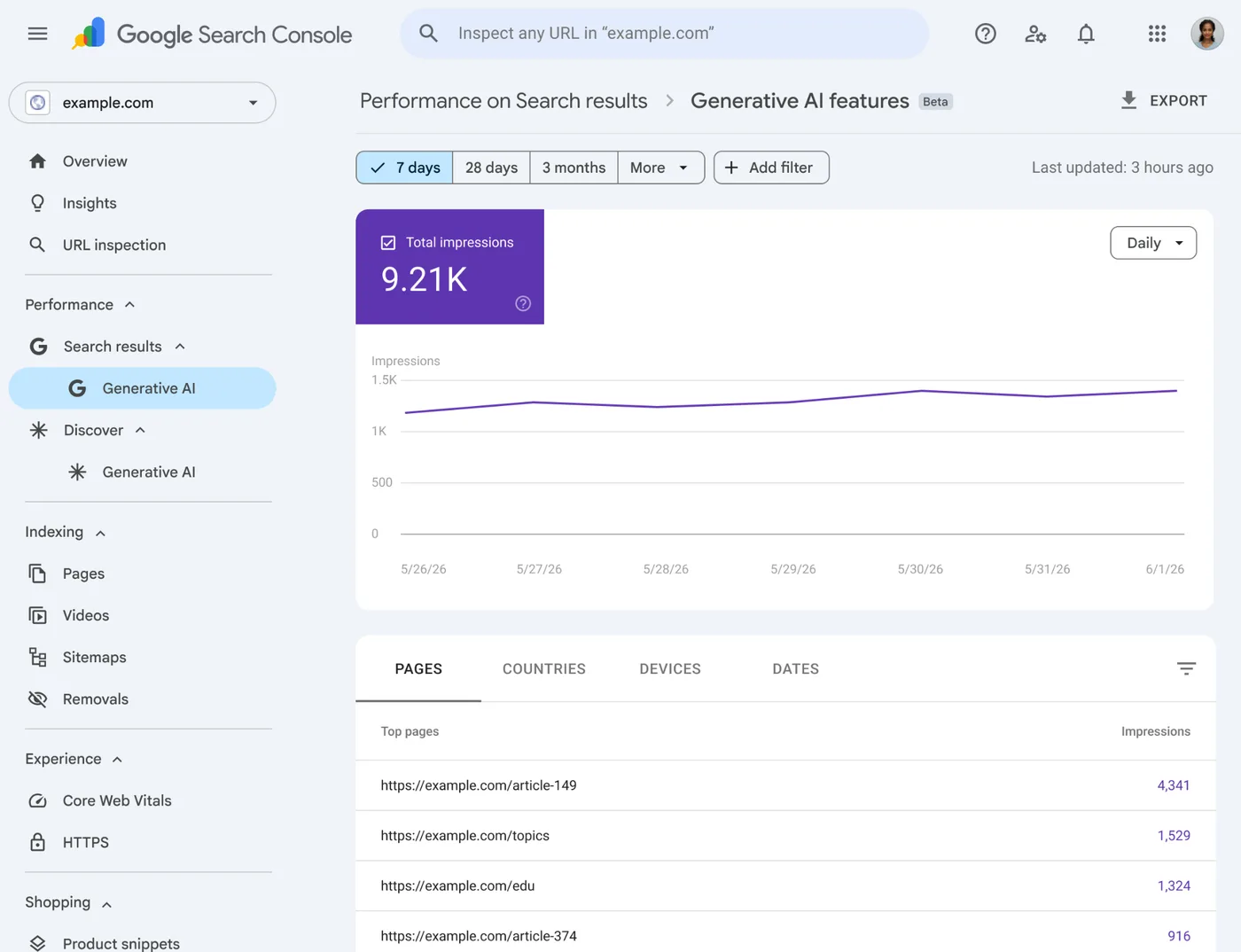
The difference is in pace and depth. Bing launched in February, Google only joined in June, and for now it offers no counterparts to metrics such as Citation Share, Intents or Topics. For a specialist this means one thing: if you want the fullest measurement of your AI visibility today, you reach for Bing Webmaster Tools, even if most of your traffic comes from Google.
This is a rare moment when Bing is a step ahead of Google. In measuring AI visibility, it really is worth taking advantage of.
How to use it in practice
Having the data available achieves nothing unless you weave it into your work. Here is how I approach it, step by step:
- 01 Set up and verify a Bing Webmaster Tools account. It is free, and you can import your sites straight from Google Search Console. Without it you will not see any AI data.
- 02 Review the grounding queries and Intents. Check for which queries and in which intents AI cites you. That tells you where you really have authority.
- 03 Read Topics as a map of gaps. Develop the topics with many citations, and treat those with a low Citation Share as an opportunity to catch up.
- 04 Correlate changes using Compare. After a major content update, check whether Citation Share has grown, and learn what works.
- 05 Write to be cited. Answer-first writing, a clean structure and E-E-A-T increase the chance that AI will take you as its source, and now you will finally see it in numbers.
FAQ: common questions
What is AI Performance in Bing Webmaster Tools?
AI Performance is a set of reports in Bing Webmaster Tools that shows how your content is cited in AI-generated answers: in Microsoft Copilot, in AI summaries in Bing and at selected partners. Unlike the classic performance report (clicks from blue links), it measures citation activity: how many times and which pages appeared as a source in an AI answer. The feature launched in public preview in February 2026 and received a large expansion in June 2026.
What is Citation Share?
Citation Share is the percentage of citations attributed to your site out of all citations shown for the same grounding query (the query on the basis of which the AI retrieved its sources). In other words: not only "were you cited" but "what share do you have" of the whole pool of cited sources. It shifts the thinking from presence to competitiveness. You see your position relative to others, much like market share.
How does AI Performance differ from the regular performance report?
The regular performance report focuses on indexing and clicks from classic blue links. AI Performance measures something else: citations in generative answers. These are two different layers of visibility: today, with AI answers, you can be rarely clicked in the classic results and at the same time often cited in the answers themselves (or the other way round). That is why these reports complement each other rather than replace each other.
Does Google have something like this?
Yes, but later and, for now, more modest. In June 2026 Google announced generative AI performance reports in Search Console, a few months after Bing launched. So Bing was first and went further, offering metrics such as Citation Share, Intents and Topics, which have no counterparts at Google yet. The direction is the same for both: more transparency about how AI uses your content.
Do these reports work for Polish websites?
The June 2026 expansion started rolling out in preview globally, so the simplest thing is to open your Bing Webmaster Tools account and check whether you already have the AI Performance section. The scope of the data depends on how often your content is cited by Microsoft's AI at all: the greater the visibility, the richer the reports. For Polish websites this is still a fresh area, but data is already appearing.
Do I need a Bing Webmaster Tools account?
Yes, and it is free. Without a verified site in Bing Webmaster Tools you will not see the AI Performance reports. Setting up an account takes a few minutes (you can import sites from Google Search Console), and in return you get data on AI citations that you cannot obtain anywhere else today. Even if your traffic comes mainly from Google, monitoring AI visibility alone makes it worthwhile.
Worth remembering
- AI Performance in Bing Webmaster Tools measures citations of your content in AI answers (Copilot, AI summaries in Bing and at selected partners).
- Four things were added in June 2026: Intents (query categories), Topics (topic clusters), Citation Share and Compare.
- Citation Share is the percentage of citations going to your site among all sources for a given grounding query: a share, not just "am I being cited".
- It is the first widely available, free way to actually measure AI visibility. Before, it was a black box.
- Bing launched this in February 2026; Google joined in June with generative AI performance reports in Search Console.
- It is worth setting up Bing Webmaster Tools even if you live off Google: data on AI citations cannot be obtained anywhere else today.
Summary
AI visibility is ceasing to be a matter of faith and becoming a metric. AI Performance in Bing Webmaster Tools, especially with Citation Share, gives you the first real tool for seeing how much you actually count in generative answers. And since it can be measured, it can also be improved deliberately.
Bing has just handed the industry its first real yardstick for AI visibility. It would be a pity not to pick it up.
Start with the simplest thing: set up Bing Webmaster Tools and look at AI Performance. Even if the numbers are modest for now, you will see something that a year ago could not be seen at all.
Sources and materials
The source announcements and documentation on which I base this analysis:
- Bing Blogs – New AI Visibility Insights in Bing Webmaster Tools (June 2026)
- Bing Blogs – Introducing AI Performance in Bing Webmaster Tools (February 2026)
- Bing Webmaster Tools – help: AI Performance
- Search Engine Land – Bing WMT updates AI reporting
- Google Search Central – generative AI performance reports
Want to measure and improve your AI visibility?
I will help you set up measurement (Bing WMT, Search Console) and plan a content strategy for AI citations. Let's start with a conversation.
Book an SEO consultationHow this text was written
I will not pretend it was written entirely by hand, by candlelight. For the research, the proofreading and the code of this page I used a language model. It is a good tool for digging through documentation and catching the typos you no longer see on the third read of your own text. The English version was also prepared with a model, from my Polish original.
What the model did not do: it did not choose the topic, form the arguments or decide what this data means for your site. That stays with me, as does the last word on what goes into the text and what comes out of it.
Where the model helped
- digging through sources and organising data
- proofreading and the English version of the text
- code, page layout and infographics
What stays with me
- the choice of topic and what is worth saying about it
- the arguments, the reading of the data and the conclusions
- fact-checking and the decision on what goes into the text

Written by
Sebastian Baryś
Freelance SEO specialist · Częstochowa, Poland, and remote
I started when nobody had dreamt of Core Web Vitals and rankings were checked by hand. Today I work on making companies visible not only in Google, but wherever people ask questions. I write only about things I check myself in client projects.