Table of contents
On 14 August, two days after this article was published, Anthropic released a separate explainer in which it describes the watermarking mechanism and answers some of the questions I had left open here. I am not rewriting the text from scratch, because a record of what was known on 12 August has a value of its own. Instead, I have added notes in five places with what has changed. Two of my sentences from that day turned out to be plainly wrong, and I am leaving them in the text together with the correction.
- The mechanism has been described publicly, contrary to what I wrote here. It is a version of SynthID-Text from Google DeepMind.
- The limit of the watermark's durability now has a name, and a translation done by Claude applies a new watermark instead of erasing the old one.
- Anthropic has explained the question of code, although I wrote that it was silent on it.
- When Claude proofreads your own text, the watermark behaves differently from what I wrote. This is the most important change in the whole explainer.
- In the section on questions without answers, one question is now settled, two have been made more precise and three are still open.
I am leaving this article with the date 12 August and with its original content, because that is what was known on that day. Quietly deleting your own wrong sentences is the cheapest route to apparent infallibility, and at the pace this industry changes, nobody gets away with it anyway.
Introduction
English version of an article first published in Polish on 12 August 2026. Read the Polish original.
As of this week, every response from the new Claude models carries a signature you will not see. On 11 August 2026 Anthropic publicly described its system for marking content: models released from 2 August weave an invisible watermark into the text they generate, and image files receive signed provenance metadata.
The direct reason is EU law: on the same day from which the new models watermark, the rules on transparency of AI-generated content began to apply. Anthropic went further than it had to, though. The watermarking works worldwide, in all products at once, including the API and access through cloud platforms, and with no way to switch it off.
I break the announcement down into specifics: what exactly works as of today, how such a watermark is built, what it does not prove (this is where the most interesting part of the story lies) and what it changes in the work of anyone who publishes content.
What you will learn:
- Which Claude models and products have been watermarking text since 2 August 2026, and why this applies to the whole world, not only the EU
- How a statistical watermark woven into the content works and how it differs from metadata attached to a file
- What Article 50 of the EU AI Act requires and what the penalties are for ignoring it
- Why Google has been watermarking text for a long time, while OpenAI keeps a finished detector in a drawer
- What the watermark does not prove, and why "processed by Claude" does not mean "written by AI"
- What really changes in the detection of AI content and whether Google will start penalising it
What exactly Anthropic announced
The core of the announcement is a help centre article titled "How Claude marks AI-generated content". The facts in it make a short list:
Which models
All models released on or after 2 August 2026 watermark from launch. For older models, Anthropic says it is working to add support and gives no date.
Which products
The Claude app, Claude Platform (API), Claude Code, Claude Cowork and Claude Tag. On top of that, models available through AWS, Google Cloud and Microsoft Foundry. Watermarking works at the model level, so it does not matter which way the text leaves.
Where
Everywhere Claude is offered. The requirement is European, the rollout is global. A user in Poland, the US or Singapore gets exactly the same watermarked text.
What about files
.svg, .png and .jpg files generated by Claude receive digitally signed provenance metadata in the C2PA standard, which also makes it possible to detect whether the file was changed later.
The key sentence of the announcement concerns the durability of the watermark: because it is part of the text itself, it travels with the text when it is copied and pasted and "may persist through some editing". That is cautious wording, and rightly so, because as you will see further on, the line between "some editing" and "the watermark is gone" is one of the most important unknowns today.
It is also worth noting what the announcement does not contain: a way to opt out. According to Forbes, no option to switch off watermarking is planned for anyone, neither on free plans nor in the API.
How a watermark in text works
Anthropic has not published the implementation details, and probably will not, because a mechanism that is public is easier to cheat. The principle behind statistical watermarks in language models is, however, well described in the literature and in SynthID, the publicly documented system from Google DeepMind, so it can be explained without guessing.
I lost that bet in two days, and I am more pleased than embarrassed. A company that shows how its watermark works stands on firmer ground than one that asks you to take its word for it.
A language model writing a response chooses, at every step, the next word from among many almost equally good candidates. "The results of the study show", "the results of the study indicate", "the results of the study suggest": for the reader there is no difference. The watermark consists in the model slightly favouring some of these equivalent choices according to a secret key. A single sentence looks ordinary. Over a longer passage the preferences add up to a statistical pattern which, if you know the key, can be counted and told apart from chance.
The watermark usually survives
- copying and pasting between applications
- a change of formatting and font
- minor corrections and cuts
- publication of a longer passage in full
The watermark is lost with
- deep paraphrasing and rewriting in your own words
- translation into another language
- very short passages: too small a sample
- interleaving with text you wrote yourself
Two things follow from this design that are worth remembering. First, the watermark does not sit in metadata, but in the words themselves, so you will not erase it with "save as txt" or by pasting into a plain-text editor. Second, it is a statistical signal, not a stamp: it needs a longer sample and will always have some margin of uncertainty.
Programmers raise a separate problem: code has far fewer "equivalent choices" than prose, because syntax and conventions force specific tokens, so the watermark's capacity is lower there, and running a file through a formatter such as Prettier may weaken it further. Anthropic has so far not said a word about code, which is a little surprising for a company with a product like Claude Code.
Image files and C2PA metadata
For files, Anthropic chose a different technique from the one for text. Images generated by Claude in the .svg, .png and .jpg formats receive digitally signed provenance metadata in the C2PA standard, the one developed by the Coalition for Content Provenance and Authenticity with the participation of Adobe, Microsoft and Google, among others. The signature makes it possible not only to state that a file came out of Claude, but also to detect whether someone tampered with it afterwards.
The difference between the two techniques is fundamental. The watermark in text is part of the content. C2PA metadata is attached alongside the content. In practice this means that the marking of a file is much easier to lose, even by accident: format conversion, re-saving in an image editor, compression on upload to a platform or an ordinary screenshot erase the metadata entirely. Anthropic lists these limitations openly.
This is a weakness of the whole C2PA standard, not of Anthropic's implementation. As long as popular social platforms and messaging apps strip metadata on every upload, provenance signatures work mainly where nobody needs them.
Why now: Article 50 of the AI Act
The date of 2 August 2026 is no accident. On that day the transparency obligations in Article 50 of the EU Artificial Intelligence Act became enforceable: providers of systems that generate content must mark the output in a machine-readable format, so that it can be recognised as generated or manipulated by AI. For breaching these obligations the Act provides, as Euronews points out, fines of up to 15 million euros or 3% of worldwide annual turnover, whichever is higher.
The practical route to compliance is the Code of Practice on Transparency of AI-Generated Content, which Anthropic signed alongside the announcement. According to TechCrunch, the companies that have also committed to the code include Google, Meta, Microsoft, OpenAI, Black Forest Labs and Synthesia, which means there will be more announcements like this in the coming months.
Why globally, if the requirement is European?
Because watermarking works at the model level, and maintaining separate variants of a model "for the EU" and "for the rest of the world" would be expensive and risky. There is also a simpler reason: a variant that watermarks only in the EU would be bypassed by most professionals without effort. A VPN or an API request through a server outside Europe would be enough, and the watermark would be gone. Euronews put it well: "EU compliance, delivered globally". It is a familiar mechanism. The GDPR set privacy standards far beyond Europe in the same way. Law written in Brussels more and more often defines a product the whole world uses. Whether that is good or bad, time will tell.
I have already written about EU digital regulation when covering the first fine for Google under the Digital Markets Act and the UK requirement to give publishers control over AI Overviews. Content marking is another front in the same war over the rules of the game between regulators and platforms.
> reading the first words of the game Fallout…
"War. War never changes."
> 2018 · GDPR / the privacy front
> 2024 · DMA / the digital markets front
> 2026 · Art. 50 of the AI Act / the content provenance front▮
Only the fronts change: first privacy, then markets, now the provenance of content. The war itself, as in the famous opening of Fallout, never changes. And as in Fallout, it is not won by whoever races against it, but by whoever has a shelter ready before the front reaches their door. In our case the shelter is a content process that does not have to be reworked in a panic after every new regulation.
What the rest of the industry does
Anthropic did not invent text watermarking. What sets it apart is the reach of the rollout. The three largest players approach the subject in completely different ways today:
Anthropic
Watermarks text and files in production, globally, in all products at once, including the API and cloud platforms. Detector: only announced so far.
SynthID has watermarked images since 2023 and text from Gemini since 2024. Google released the text technology as open source. A public verifier works for some formats.
OpenAI
According to reports from 2024, it has a finished detector for ChatGPT text with a claimed accuracy of 99.9%, and keeps it in a drawer, partly for fear of losing users.
Just as much is happening outside the big three. Suno, the music generation platform, announced watermarking of tracks after a wave of lawsuits from record labels. Substack partnered with Pangram to label AI-generated text in publications on its platform. The direction is the same everywhere: the era of AI content with no trace of origin is coming to an end, at least at the level of declarations by the largest providers.
For me, the most telling item in this comparison is the stance of OpenAI. A tool with a claimed accuracy of 99.9% sits in a drawer because releasing it would hurt the business. That says more about the industry's priorities than all the declarations on transparency put together.
Anthropic has taken a step that competitors avoided for years, and it will pay for it with some users leaving for other LLMs. But will that change anything, if the others are likely to roll out the same thing shortly?
So I am watching whether the other signatories of the code deliver anything more than a signature.
What the watermark does not prove
Here we reach the part that the media covering the announcement are most willing to cut short, and which in practice decides everything. Anthropic itself states that a detected mark tells you only that the content "may have been processed by Claude". It does not prove that Claude wrote it. And this is not a lawyer's hedge, but a fundamental property of the technique.
The best example is right in front of you. This article was created with the help of Claude, and I say so openly in the note at the end of the page. The visual layer (the infographics, the insets, the whole layout) is much better for it than if I had done it alone. But the context, the judgements and the conclusions are my own.
If someone ran this text through a future detector, they would see only "processed by Ay-Eye" :) and would learn nothing from it about where the tool ends and the author begins.
I am not an exception. A similar case went round social media after the announcement. A well-known American radio commentator complained that he had dropped Grammarly in favour of Claude for proofreading his own texts, and now his columns would carry a mark suggesting that a machine wrote them. He is right about the mechanism: proofreading, editing or translating your own text with Claude leaves exactly the same watermark in it as generating a text from scratch. The watermark does not tell an author from a proofreader.
This is the best news in the whole announcement, and it happens to be the one that undermines my own sentence from two days earlier. Proofreaders, editors and translators can sleep more easily. I would not sleep too soundly, though, because the threshold between light and heavy editing is set by the same company that sells the model.
Watermark present ≠ AI authorship
The watermark says "this text passed through Claude". It does not say whether Claude wrote the whole thing, fixed the commas or translated someone else's draft.
No watermark ≠ human text
The text may have come from ChatGPT, from Gemini without a watermark, from an older Claude model, or from a watermarking model and then been paraphrased. Anthropic says so directly: the lack of a mark does not mean the content did not come from AI.
Watermark exists ≠ watermark can be checked
There is no public detector. Anthropic is only working on making detection mechanisms available. As of today, only Anthropic can read the watermark. It is also unknown whether the tool will go to everyone or only to platforms and institutions.
Limit of durability = unknown
How much editing erases the watermark? TechCrunch put this question to Anthropic and did not get an answer before publication. "May persist through some editing" is all the official knowledge there is for now.
The community's reactions were predictable: on X and Reddit the announcement drew comments ranging from declarations that the era of unverifiable AI writing is over to sharp criticism of the missing opt-out. The loudest protests come from those who use Claude as a tool for working on their own text (proofreaders, translators, editors), because the gap between "processed" and "written" hits them hardest.
For two years clients have been asking me whether "Google will detect" that a text was written by AI, and for two years I have been answering that the detectors so far guess from style, and guessing can do real harm. The watermark is the first technique that detects on the basis of mathematics, not stylometry, and that is a change for the better.
As long as there is no public verifier, fortune-teller tools will keep circulating, now with the added credibility of the line "but AI is watermarked, isn't it".
In this respect the coming months will be worse, not better.
What it changes in SEO and content work
I will start with the question that everyone who publishes AI-assisted content will ask: will Google start penalising text with a watermark? Nothing points to that. Google's position has been the same for years: what is assessed is the quality and usefulness of content, not how it was produced, and penalties fall on mass production for search engines, not on the use of tools as such. A watermarked text that answers a user's need has no reason to rank worse.
Should really good content made with AI be "devalued" in favour of weak content from a copywriter or an author? The reader does not care who held the keyboard. They care whether they got an answer to their question.
What changes is something else: for the first time, platforms get a machine-readable signal of where content comes from. Until yesterday, every claim of "we detect AI content" rested on guessing. If watermark detectors become available to search engines, social networks or advertising systems, these will gain a solid basis for labelling, filtering or otherwise treating such content differently, and each of them will make its own decision about what to do with the signal.
For the content services market the consequence is more personal. Some agencies and copywriters today sell "hand-written" texts that are not hand-written. As long as detection was guesswork, that pretence was safe. In a world where a client may one day run a delivered text through an official verifier, a statement about how you work becomes checkable, and in my view that is the deepest change watermarking will bring to this industry. Not "was it AI", but "did you tell the truth about how you work".
People are already searching for this: data from Poland
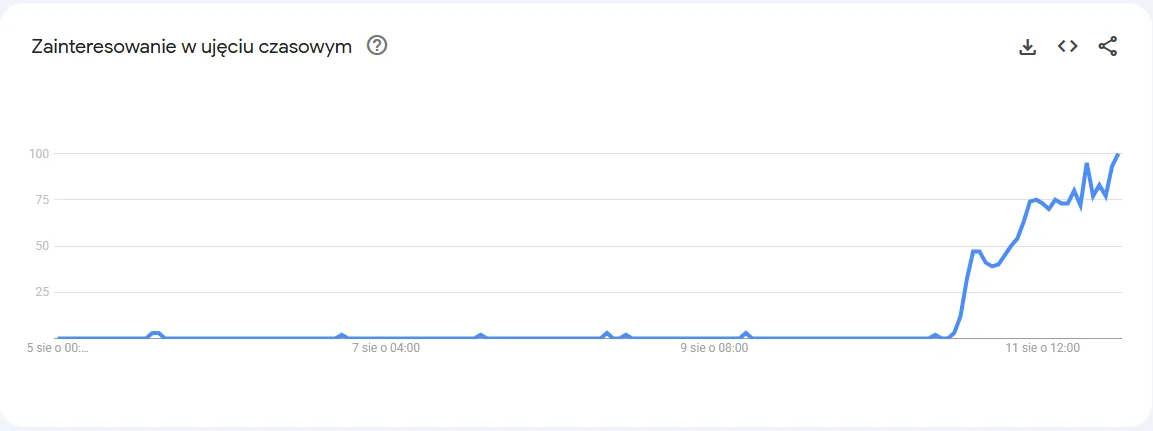
The query "detektor AI" (AI detector) gets 5,400 searches a month on Google in Poland, and "detektory AI" (AI detectors) another 3,600. Demand for checking where texts come from has existed for a long time. Until now it was served by tools that guess from style. Globally, interest in the subject exploded on the day of the announcement: in Google Trends the queries "does claude watermark text" and "claude watermarking" have breakout status, most strongly in Germany, the Netherlands and Singapore. In Polish searches the subject does not exist yet.
Finally, there is the matter of transparency. Watermarking on the model side and labelling on the platform side, as with Substack and Pangram, shift the norm: openness about the part AI played in creating content stops being a whim and starts being an expectation. Anyone with a clear conscience on this has nothing to fear from a watermark. I covered AI bots' access to content, the other side of the same coin, when writing about OpenAI's crawlers and robots.txt and Cloudflare's blocking of bots.
My own position on this is simple. Under every article on this blog there is a note, "How this text was written", describing the part AI played. I added it long before this announcement, because I believe the reader has a right to know how I work. The watermark changes nothing in my work: I speak about the use of AI openly, so no detector will "expose" anything here that is not already written in black and white. And this is the strategy I recommend to every client, not because watermarking forces it, but because sooner or later it will.
Questions without answers
An honest account of this announcement also has to include a list of things we simply do not know. I am noting them here, and I will come back to this article when they are cleared up:
- How much editing does the watermark survive? Who knows? "May persist through some editing" is the only official answer. Without that knowledge it is impossible to judge whether the watermark is a real barrier or a fig leaf. I think SEOs will find a way. Just as in the old era of article spinners and synonymisers such as SeoLight or SeoBohater (Polish tools of that kind), here too the market will come up with something interesting.
- Who will get the detector? A public tool for everyone, an API for platforms, or access only for institutions? Whether the watermark changes anything in practice depends on this decision. Let us not fool ourselves: the EU did not introduce the AI Act just to have it, but to impose penalties. And watermarking is the first of the means.
- What is the false positive rate? Every statistical signal has one. For a tool that may decide whether a student or an employee is accused, that number matters more than accuracy itself.
- What about older models? Support is being worked on, with no date. Until then a large share of API traffic generates text without a watermark.
- Will enterprise contracts get an exception? Officially there is no opt-out. The history of the industry suggests that the largest customers can negotiate things that are not on the price list.
- Will the other signatories also roll it out globally? Almost all the largest companies signed the code. If OpenAI and Meta limit watermarking to the EU, we will get a strange world in which the provenance of a text depends on the author's IP address.
FAQ: common questions
Does Claude add a watermark to every text?
To text from models released on or after 2 August 2026, yes, in every product: the Claude app, the API, Claude Code, Claude Cowork and Claude Tag, and also through cloud partners (AWS, Google Cloud, Microsoft Foundry). According to Anthropic, support for older models is still being added, so their responses may not carry the watermark yet.
Can the Claude watermark be switched off?
There is no such option. Watermarking works at the model level, so it covers every access route, including the API. Anthropic does not describe any exception for business customers, and press reports indicate that no opt-out is planned. If that changes, it will most likely be in enterprise contracts.
Can I check whether a text carries the Claude watermark?
Not yet, but the form it will take is already known. In its explainer of 14 August, Anthropic announces an API for detecting the watermark ("We will soon be offering a watermark detection API"), adding that it is still working out the details of the rollout. No date was given, nor who will get access. Until then the watermark exists, but only Anthropic can read it.
Does paraphrasing remove the watermark?
Deep paraphrasing does. The explainer of 14 August makes the boundary more precise: light editing is unlikely to remove the watermark completely, but rewriting the text so that every word is replaced certainly will. Interleaving Claude's text with your own writing and quoting short passages work in a similar way, because the watermark needs a longer sample to be statistically visible. Be careful with translation: running Claude's text through another tool loses the watermark, but a translation done by Claude itself applies a new one, because every word in such a translation is chosen by the model.
Does the watermark lower the quality of the text?
According to Anthropic, no: the watermark does not change the meaning, quality or readability of a response. The company explained the question of code on 14 August, and the explanation is reassuring: where the output has to be exact, because a different word would break a program or distort a fact, the watermark is not applied at all. Code therefore carries less watermarking than prose by design, and what remains ends up mainly in comments.
Will Google penalise me for AI content with a watermark?
There are no grounds for saying so. Google has long repeated that it assesses the quality and usefulness of content, not how it was produced. Penalties concern mass production of content for search engines, not the use of AI as such. The watermark does, however, give search engines and platforms a machine-readable signal of origin that they did not have before. How they use it is a separate decision for each of them.
Do other AI models watermark text too?
Google weaves the SynthID watermark into text from Gemini and has released the technology as open source. OpenAI, according to reports from 2024, has a finished detector for ChatGPT text with a claimed accuracy of 99.9%, but has not released it for fear of losing users. In images and video, watermarking is far more common than in text.
Does the watermark prove that a text was written by AI?
No. Anthropic says so directly: the watermark indicates only that Claude probably had something to do with the content, and it "cannot distinguish “Claude wrote this” from “Claude heavily edited this”". The distinction between author and editor therefore stays out of reach of this technique. There is one clarification in favour of people who write: in ordinary proofreading, where almost all the words are human, the watermark has nothing to attach to. The problem starts with heavy editing.
Worth remembering
- Claude models released from 2 August 2026 weave an invisible watermark into the text they generate. This covers every product (the apps, the API, Claude Code) and the whole world, not only the EU.
- The watermark sits in the content itself, not in metadata. It survives copying and pasting and light editing. It is lost when the text is rewritten word by word, when it is translated by a tool other than Claude, and in very short passages. A translation done by Claude itself applies a new watermark instead.
- The presence of the watermark proves only that Claude probably had something to do with the text. It does not tell an author from an editor where the editing is heavy, but ordinary proofreading of your own text by Claude leaves very little or nothing.
- The absence of the watermark proves nothing the other way. The text may have come from another model, from an older Claude, or may simply have been heavily reworked.
- There is no public tool for checking the watermark yet. Anthropic has announced a detection API, but with no date and no information on who will get access. Until then the watermark exists, but nobody outside can read it.
- Google's policy has not changed: what counts is the quality of the content, not how it was produced. The watermark does, however, give platforms their first machine-readable signal of origin, and it is sensible to assume that in time they will start using it.
Summary
Anthropic has done something the industry had talked about for years and consistently avoided: it switched on text watermarking in production, everywhere and without exceptions. Brussels forced it, but the scale of the rollout (global, at the model level) was the company's own decision.
The watermark says "this text passed through Claude". It does not say who wrote it. All the value and all the risk of this technology fit in the difference between those two sentences.
As of today, less changes than the headlines suggest: the watermark exists, but there is no public tool that can read it. The real test will come with the detector. Whether this ends in more honesty or in a wave of false accusations depends on who gets it and how carefully it separates "processed" from "written".
One thing you can do straight away, whatever happens next: put your own disclosure policy in order. If you use AI in creating content, your own or your clients', say so plainly before someone's verifier says it for you. It is a five-minute decision, and it separates a strategy from counting on luck.
And one more forecast to finish: local LLMs may come out of all this as the winners. A model run on your own hardware will weave in no watermark, and after suitable fine-tuning it will still allow content to be produced at scale. All the more so because the strongest open models today are largely Chinese (DeepSeek or Qwen), and although China has its own, by no means milder, rules on labelling AI content, they bind services, not the model weights you downloaded and ran yourself. I suspect part of the market will move exactly there: the tighter the watermarking at the large providers, the stronger the case for a model that nobody signs.
Sources and materials
The announcement, press coverage and documents on which I base the facts and figures cited:
- Anthropic Help Center: How Claude marks AI-generated content (primary source)
- Anthropic: How Claude's text watermarking works (14 August 2026, description of the mechanism and FAQ)
- TechCrunch: Anthropic says it will watermark text generated by its AI models (11 August 2026)
- The Decoder: Anthropic watermarks all Claude outputs globally (11 August 2026)
- Euronews: EU compliance, delivered globally (11 August 2026)
- Forbes: user reactions to the watermarking of Claude content (11 August 2026)
- EU AI Act, Article 50: transparency obligations for providers of AI systems
Not sure how to combine AI with the content on your site safely?
I help set up a content process, with AI or without, that supports visibility instead of putting it at risk.
See AI SEOHow this text was written
I will not pretend it was written entirely by hand, by candlelight. For the research, the proofreading and the code of this page I used a language model. It is a good tool for digging through documentation and catching the typos you no longer see on the third read of your own text. The English version was also prepared with a model, from my Polish original.
What the model did not do: it did not choose the topic, form the arguments or decide what this data means for your site. That stays with me, as does the last word on what goes into the text and what comes out of it.
Where the model helped
- digging through sources and organising data
- proofreading and the English version of the text
- code, page layout and infographics
What stays with me
- the choice of topic and what is worth saying about it
- the arguments, the reading of the data and the conclusions
- fact-checking and the decision on what goes into the text

Written by
Sebastian Baryś
Freelance SEO specialist · Częstochowa, Poland, and remote
I started when nobody had dreamt of Core Web Vitals and rankings were checked by hand. Today I work on making companies visible not only in Google, but wherever people ask questions. I write only about things I check myself in client projects.