Table of contents
Introduction
English version of an article first published in Polish on 24 September 2026. Read the Polish original.
Between 15 and 18 September 2026 Google stopped showing free product listings and the “Popular products” carousel in the European Economic Area. These were the placements where products from many shops, with a price and a photo, stood side by side without anyone paying for an ad. Product ads stayed, the free shelf disappeared.
In a large Polish shop whose data I have access to, clicks from these placements fell by 88.5% in the first week. I am not naming the shop, and the screenshots have had anything that identifies it removed. I show the numbers below, together with how to check the same thing in your own Search Console.
This is the next chapter of a story I covered when writing about the €890 million fine for Google and about the new Google results in Europe. Those pieces were mainly about hotels and flights. This one is entirely about shops. At the end I also say plainly what I think of the change, because in my view the EU hit a channel that was actually helping shops.
You will learn:
- What exactly disappeared from Google results in the European Economic Area and how we know it is a consequence of the DMA
- What results for product queries look like in Poland today, with two examples from 23 September
- How many clicks a large Polish shop had from these placements and how far they fell in the first week after the change
- How to isolate in Search Console the traffic that free product results used to bring, and what this filter does not show
- What shops are left with: product ads, comparison sites operating in the CSS programme and their own website
- Why I think the EU removed a channel that helped shops and left AI Overviews untouched
What disappeared from the results
Two things disappeared. The first is free product listings: product results with a price, a photo and the shop’s name, which Google built from the feed in Merchant Center or from structured data on the page. The second is the “Popular products” carousel, which appeared for shopping queries and gathered offers from many shops in a single strip. According to Productrise, before the change it was visible for about 85% of the commercial queries it tracked.
The first account of the drop was published on 17 September by Productrise. In its tool’s data, the presence of product carousels fell by 90–100% in Germany, France, Belgium, Sweden and the Netherlands within two days. For the remaining EEA countries, Poland included, the tool did not have enough data. Semrush showed similar drops. A day later came confirmation from Google. According to a comment published on LinkedIn by Ginny Marvin, Google’s Ads Liaison, free product listings disappeared because of the decision made under the DMA.
Outside the EEA nothing has changed. In the US, the UK and Australia the carousels work as before, which you need to keep in mind whenever you compare data between markets.
Nine years of dispute over shopping on Google
-
27 June 2017
€2.42 billion fine over Google Shopping
Commission: Google favoured its own comparison service; the CJEU upheld the fine on 10 September 2024
-
1 July 2026
Judgment in the PriceRunner case
a Stockholm court awards Klarna’s comparison site about SEK 14.3 billion; Google announces an appeal
-
23 July 2026
€460 million fine under the DMA
for favouring shopping, hotels, transport and sport (the Search part of the €890 million total); 60 days to make changes
-
8 September 2026
New results layout in the EEA
aggregator and supplier units; a letter from 12 comparison sites to the Commission
-
15–18 September 2026
Free products disappear
the “Popular products” carousel and free product listings across the EEA
-
21–25 September 2026
End of the 60-day deadline
the exact date depends on the day the decision was served
In place of the carousel Google is introducing a comparison-site module. Productrise showed it using the query “airfryer” as an example: a list of several comparison sites, one expanded by default, and a click on a product leads to the comparison site’s page, not the shop’s. According to the same source, Google Shopping appears in this module as one of the comparison sites. Google’s documentation confirms that in the EEA the aggregator unit also covers product queries and that comparison sites apply for it through the Comparison Shopping Services programme.
What it looks like in Poland
On the morning of 23 September I checked two typical shopping queries in Google, signed out, from a location in Poland: “airfryer” and “sofa do salonu” (living-room sofa). Before the change, queries like these usually came with the “Popular products” carousel (“Popularne produkty” in the Polish interface). Now it is not there.
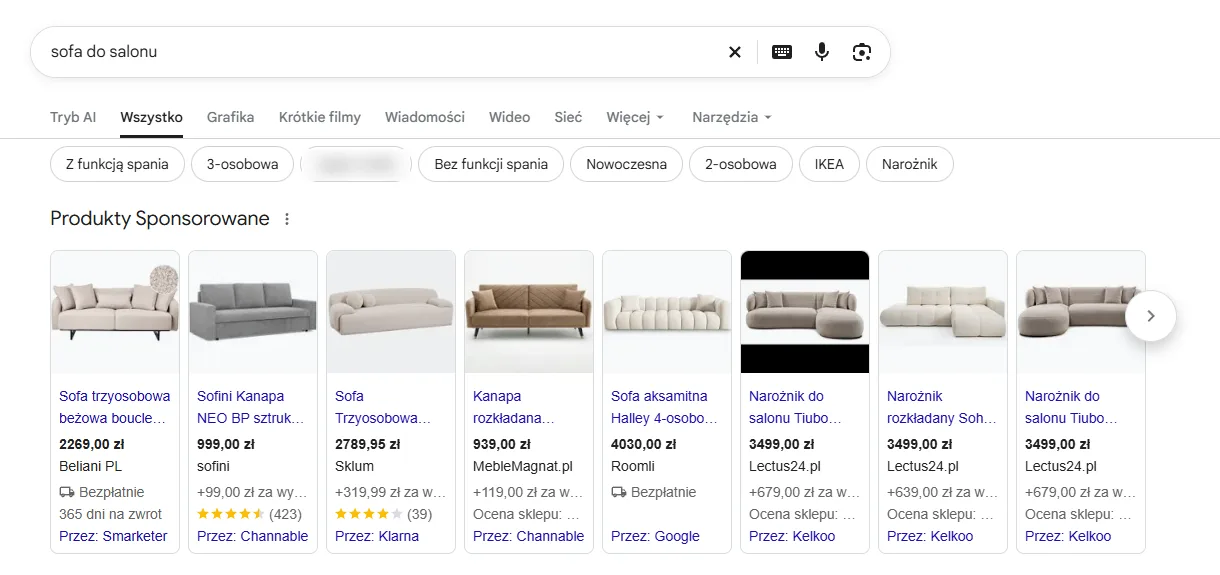
At the top of the results sits the “Produkty sponsorowane” (Sponsored products) strip. These are ads, not free listings. Note the line under each product: “By: Google”, “By: Kelkoo”, “By: Channable”, “By: Sembot” (“Przez:” in the Polish interface). It is the name of the comparison site, that is the CSS, through which the shop buys the product ad. In Europe this line has been there for years, but now that there are no free product results next to it, it is plain that the whole top product shelf is advertising.
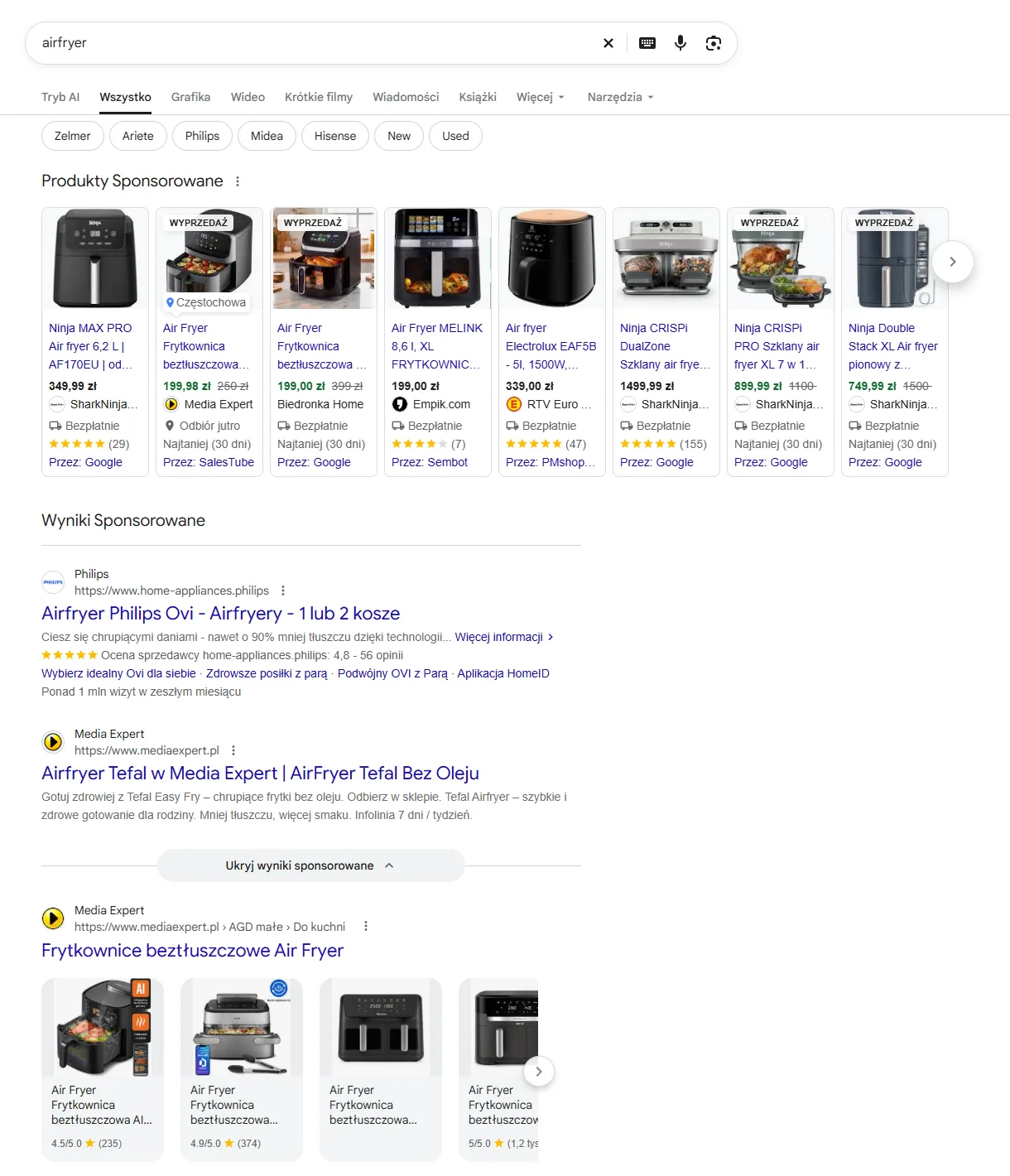
The “airfryer” results show one more thing. The first organic result is the category page of a large electronics shop, and below it a strip of that shop’s products with ratings. This is not a carousel of many shops, just products from a single site. Google’s documentation describes results of this type as carousels from structured data, available in the EEA in beta. I do not know whether this particular strip comes from that mechanism, but it shows the direction: a shop’s products can appear in ordinary results today, only through its own page.
What is missing from my screenshots? The comparison-site module that Productrise described in other countries. I did not see it for either query in Poland. Perhaps it appears for other queries, perhaps it is being rolled out gradually, and perhaps it depends on how many comparison sites operate in a given country. Two queries are too few to settle that, so I am only reporting what I saw.
How much traffic it was: a shop’s data
The news that something has disappeared from the results says little until you know how much it used to bring. Below is Search Console data from a large Polish online shop. The filter is set to search type “Web” and search appearance “Merchant listings”. I explain what exactly this filter counts in the next section.
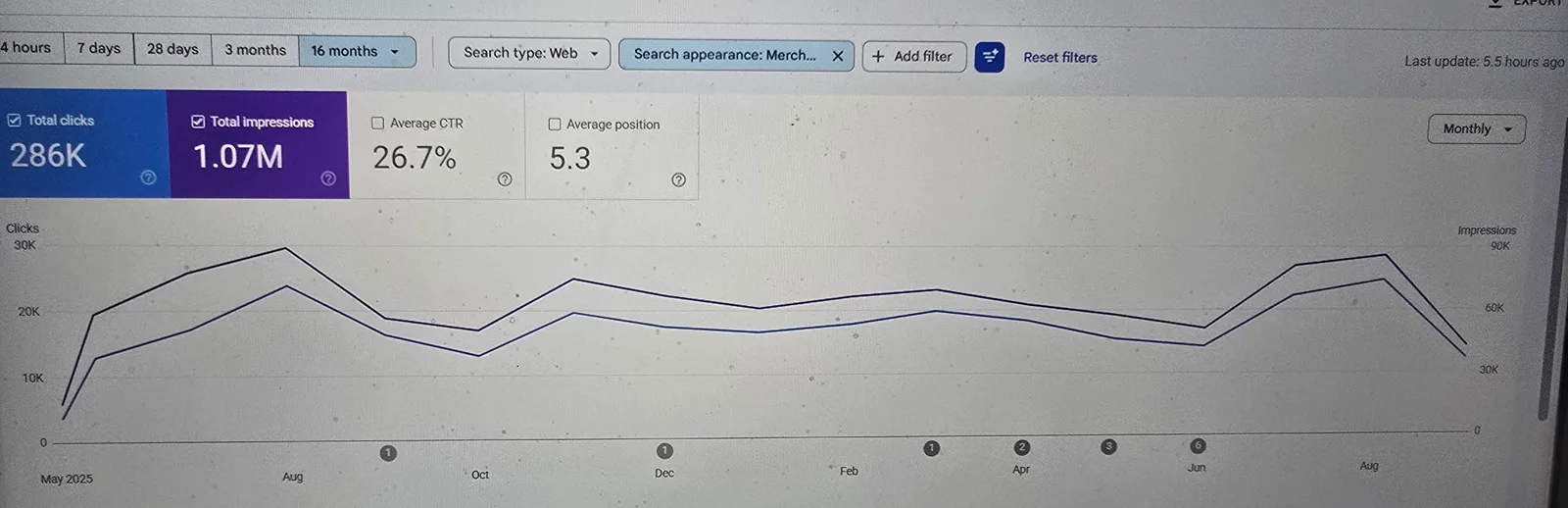
Over 16 months, merchant listings brought this shop 286K clicks from 1.07M impressions. The average CTR was 26.7%. That is a lot for organic traffic, which makes sense: someone who sees a specific product with a price and clicks on it is already close to buying. The chart shows that in a typical month this was between ten and twenty thousand clicks, and at the seasonal peak more than twenty thousand.
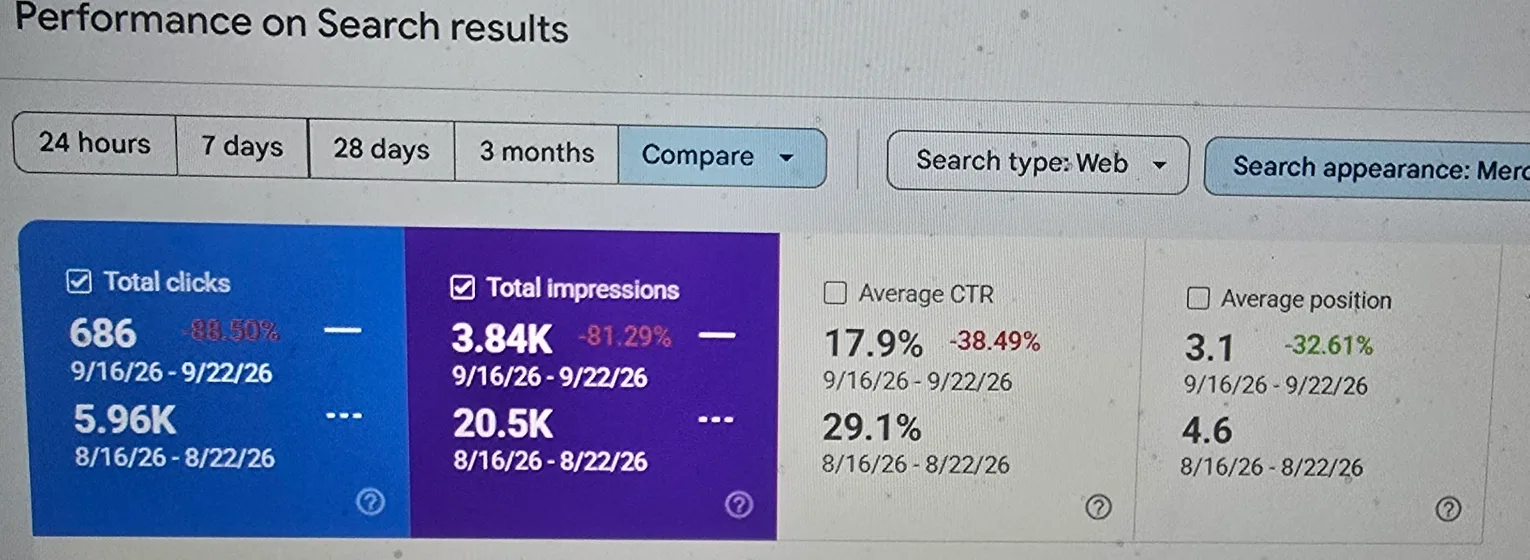
The week after the change against the week before it
In the week of 16–22 September the shop got 686 clicks from merchant listings, against 5.96K in the same week of August. That is a drop of 88.5%. Impressions fell by 81.3%, from 20.5K to 3.84K, and CTR from 29.1% to 17.9%. The average position improved from 4.6 to 3.1, but that is not good news. This is what the metric looks like when only the remnants of impressions are left in a few placements and everything else is gone.
Three caveats about these numbers
- Seasonality. August was the peak month for this shop. A year earlier, traffic from merchant listings also fell between August and September, but the chart shows a fall of roughly one third, not close to 90%.
- Timing of the change. In other countries the carousels disappeared between 15 and 18 September. Some of the 686 clicks may come from the first days of the week, before the change reached all queries.
- One shop. This is data from one large shop in one sector. In your shop the scale may be different. The direction probably not.
How to check it in Search Console
The traffic from the removed placements can be isolated in Search Console. Since 2022 the Performance report has split product results into two search appearance types: Merchant listings and Product snippets, the latter being product details shown with an ordinary organic result. According to Google’s documentation, merchant listings include, among other things, the “Popular products” carousel and the product knowledge panel. Exactly what disappeared.
- 01 Open the Performance report for search results. Leave the search type on “Web”.
- 02 Add the search appearance filter. Choose “Merchant listings”. If this item is not on the list, your products did not appear in these placements and the change does not affect you.
- 03 Compare full weeks. 16–22 September with 16–22 August, and to control for seasonality also September with September of the previous year. Seven consecutive days always contain each day of the week once, so this comparison is fair.
- 04 Set it against all organic traffic. Remove the filter and check what share of all clicks from search came from merchant listings. That will tell you whether the loss is cosmetic or serious.
- 05 Switch to the daily view. You will see on which day the change reached your shop. That will help you separate it from other events in the same period.
Search Console shows the lower bound of the loss
The merchant listings filter with the “Web” search type counts only ordinary search results. It does not include clicks from the Shopping tab, Google Images or Lens. A fuller picture comes from the performance report in Merchant Center, which counts free clicks from all Google services separately from paid ones. The numbers from the two tools will not match, and they should not.
What is left: ads and comparison sites
Product ads work as before. Here, though, the European market has had its own peculiarity for years, and it is worth knowing. Since 2017, after the fine for favouring Google Shopping, a shop in the EEA does not buy a product ad directly from Google. It does so through a comparison site operating in the Comparison Shopping Services programme, CSS for short. Poland is on the list of countries in this programme.
Most often that is Google Shopping, because it is the default setting, which many shops have never changed. Then you see “By: Google” under the ad. You can, however, choose another partner, for example Kelkoo, Channable, Smarketer or the Polish company Sembot. Partners differ in billing model and in the range of services. After the September change this choice stops being a technical detail, because the top product shelf is now advertising only.
How a shop’s product reaches the results in the EEA today
gone
Free listings and “Popular products”
product result with a price, a click straight to the shop, no fees
paid
Product ad through a CSS
Google Shopping or another partner; the rules are unchanged
organic
The shop’s own website
ordinary result, product snippet, single-site carousel, supplier unit
What we still do not know
- Whether free product listings have stayed on the Shopping tab, in Google Images, in Lens and on YouTube. As of 23 September the Merchant Center help page still lists these placements and says nothing about changes in the EEA.
- Whether Google will bring back some free format. It has not announced that and has not stated the scale of the lost traffic.
- How the Commission will assess the changes after the 60-day deadline, which ends between 21 and 25 September, depending on the day the decision was served.
- When, and for which queries, the comparison-site module will appear in Poland.
The dispute over the shape of the module
You might think the comparison sites are pleased, since they get the space left by Google’s carousel. Not entirely. On 8 September twelve European companies from this sector, grouped as the CSS Group, wrote a letter to the leadership of the European Commission and the officials responsible for the DMA. One of them is the Polish company Sembot.
The Commission is working on a model in which every comparison site has its own ad unit in the results. The CSS Group fears that if Google Shopping gets a separate, closed module to which the other comparison sites have no access, shops will go back to advertising through Google anyway so as not to drop out of sight. That is why the group demands that Google Shopping bid in every module, including competitors’ modules. By its own estimates the coalition serves more than 93,000 merchants, and it puts Google Shopping’s share of the CSS market at over 50%. It did not give the methodology behind these figures.
“Less competition in the advertising market means higher customer acquisition costs. Shops may try to pass them on in product prices.”Michał Zieliński, COO of Sembot, speaking to Wirtualnemedia.pl (a Polish media-industry news site), 16 September 2026 (my translation)
There is one more case in the background which shows that the subject will not go away. On 1 July 2026 the Patent and Market Court in Stockholm ordered Google to pay PriceRunner, a comparison site owned by Klarna, about SEK 14.3 billion in damages for years of favouring Google Shopping. That is less than the amount claimed, but still a record in Swedish competition cases. The judgment is not final, and Google has announced an appeal. Other comparison sites now have a template for calculating their own losses.
My view: the EU is aiming at the wrong target
Up to this point I have tried to describe facts. Now my opinion, because after 18 years in SEO I find it hard to comment on this change neutrally.
I think the EU got rid of something that was actually helping shops. Free product listings and the “Popular products” carousel worked simply: the buyer saw a specific product with a price and clicked straight through to the shop selling it. No fee for the shop and no intermediary in the middle. The data above shows that this traffic had a CTR of 27–29%, so the people clicking knew the product and the price before they entered the shop. In my experience, traffic like that sold relatively better than the average visit from search. What did shops get in return? A choice: a paid ad, or the module of a comparison site that will stand between them and the customer.
I understand the Commission’s logic. For years Google favoured its own comparison service, the EU courts confirmed it, and the DMA prohibits such practices. But the effect of regulation is measured by what happens to the shop, not by whether comparison sites got a place at the top. From the shop’s point of view, a free sales channel has turned into a paid or an indirect one.
What strikes me even more is what the regulation did not touch. AI Overviews cut organic traffic across the whole of the results, and on that front the EU has changed nothing. According to a Pew Research study from July 2025, users who saw an AI summary clicked on an ordinary result in 8% of visits, against 15% without a summary. Ahrefs, in data from December 2025, calculated that the presence of an AI Overview lowers the CTR of the first result by 58%. In its July decision the Commission merely noted Google’s proposals concerning generative features and announced further dialogue. The antitrust proceedings opened in December 2025 concern whether Google uses publishers’ content without payment, not the traffic that websites are losing.
In fairness, one thing has to be added. My two screenshots of product queries showed no AI summary. In a shop, AI Overviews mainly hit guide content, queries such as “jaki airfryer wybrać” (which air fryer to choose), which is an earlier stage of the buying journey. But it is the same customer and the same shop. On one side it loses traffic at the stage of choosing, on the other, since September, at the stage of buying.
A regulation that was meant to limit Google’s advantage is, in this case, felt most by shops. Comparison sites got a place, Google kept its ads, and the shop lost a free spot next to its competitors, with the price visible straight away. The changes that really shift traffic in search, AI answers, remain out of Brussels’ reach for now.
What to do in your shop
Opinions aside, a shop has to sell in the results as they are. Here is the order I suggest starting with.
01. Measure how much you lost
Search Console with the merchant listings filter and the performance report in Merchant Center, split into free and paid clicks. Write down the numbers for the week before the change and the week after it.
02. Check which CSS you use
In Merchant Center you will see which comparison shopping service your ads run through. If it is Google Shopping because nobody has ever changed it, compare the offers of several partners. They differ in billing model and in service.
03. Do not switch off the feed
The feed supplies the ads and can supply other Google services for which Google has not announced any changes. Look after prices, availability, photos without overlays and correct product identifiers.
04. Strengthen product and category pages
The classic organic result stays. Product and Offer structured data with price and availability help to show a rich result, and a category page marked up with ItemList data can compete for a carousel from a single site, available in the EEA in beta.
05. Be where the top spot is now
If comparison sites appear for your queries, your products should be in them. If the comparison-site module appears in Poland, Polish comparison sites may become a source of visibility in Google itself, and not only of traffic from their own pages.
06. Recalculate the ad budget
Some of the sales that free results used to bring can now come only from ads. Watch the cost per click and the return on product campaigns from mid-September before you raise bids.
The most important change is in how you think about your own website. As long as Google showed products for free, some shops treated product pages as an add-on to the feed. Now the only thing left in ordinary results is what is on the page: its content, its structured data and how well it answers the query. If you would like me to review this in your shop, have a look at my e-commerce SEO service.
FAQ: common questions
What disappeared from Google Shopping in Europe in September 2026?
Between 15 and 18 September 2026 Google stopped showing free product listings (organic product results with prices) and the “Popular products” carousel in ordinary search results in the EEA. According to Productrise data, their presence fell by 90–100% in Germany, France, Belgium, Sweden and the Netherlands within two days. Paid product ads were not changed.
Does this change apply to Poland?
Yes. It applies to users across the whole European Economic Area, and Poland is part of it. On 23 September 2026 the results in Poland for the queries “airfryer” and “sofa do salonu” (living-room sofa) had no “Popular products” carousel, only sponsored products. Search Console data from a large Polish shop shows an 88.5% drop in clicks from merchant listings in the first week after the change.
How do I check in Search Console how much traffic free product results brought?
In the Performance report set the search type to “Web” and add the search appearance filter “Merchant listings”. Then compare the seven days from 16 September with the same seven days a month earlier. Remember that this filter does not cover the Shopping tab, Google Images or Lens. The performance report in Merchant Center gives a fuller picture of free clicks from all Google services.
Does Merchant Center still make sense now that the free results are gone?
Yes. Product ads run through Merchant Center, and feed data can supply other Google services, for example the Shopping tab, Google Images or YouTube. As of 23 September 2026 the Merchant Center help page still lists these placements and does not mention changes in the EEA, and Google has not announced what exactly is happening to free listings outside ordinary search results. Switching the feed off today would be a decision made blind.
What does “By: Google” or “By: Kelkoo” under a product ad mean?
It is the name of the comparison site, that is the CSS (comparison shopping service), through which the shop runs its product ads. In the EEA, Poland included, a shop has to use some CSS. The default is Google Shopping, and then you see “By: Google”. A shop can choose another partner, for example Kelkoo, Channable, Smarketer or the Polish company Sembot, and then that partner’s name appears under the ad. In the Polish interface the label reads “Przez:”.
Will product ads get more expensive after this change?
Nobody knows. Google has not changed the auction rules. The comparison sites grouped in the CSS Group warn, however, that if shops lose free visibility and move their budgets into ads, competition in the auction will increase. According to Sembot’s COO, quoted by Wirtualnemedia.pl (a Polish media-industry news site), less competition in the advertising market means higher customer acquisition costs. It is worth watching the cost per click in product campaigns from mid-September onwards.
Will free product results come back?
Google has not announced that. It has not stated the scale of the lost traffic either, or whether a similar change will reach markets outside the EEA. The European Commission has not yet announced its assessment of the changes after the 60-day deadline from the July decision. It is more sensible to assume that the current layout will stay for longer.
Worth remembering
- Between 15 and 18 September 2026 Google removed free product listings and the “Popular products” carousel in the EEA. Productrise measured a 90–100% drop in their presence in five countries, and Google confirmed that it is a consequence of the DMA.
- The change applies only to users in the EEA, Poland included. In the US, the UK and Australia the results are unchanged.
- Paid product ads work as before. The “By:” label under each of them shows the comparison shopping service (CSS) through which the shop runs the ad.
- In the data of a large Polish shop, clicks from merchant listings in the week of 16–22 September fell by 88.5% against the same week of August, and impressions by 81.3%.
- This traffic is visible in Search Console: search type “Web” and the search appearance filter “Merchant listings”. The filter does not cover the Shopping tab or Google Images, so it is the lower bound of the loss.
- Comparison sites are in a dispute with the Commission over the shape of the shopping module. They fear that shops will go back to advertising through Google anyway and that customer acquisition costs will rise.
- In my view the EU removed a channel that took the buyer straight to the shop and did nothing about AI Overviews, which cut clicks across the whole of organic search.
Summary
Since mid-September 2026 a shop in Europe can no longer get into Google results with a product result for free. It is left with product ads through the comparison shopping service of its choice, a presence on the comparison sites themselves and its own website in ordinary results.
The scale of the loss depends on how much the shop used to get from these placements. In the data I showed, it was between ten thousand and more than twenty thousand clicks a month, and in the first week after the change less than 12% of that was left. Before you decide anything about the budget or a change of CSS, check your own numbers in Search Console and Merchant Center. It will take a quarter of an hour. What comes afterwards will take longer: rebuilding product and category pages so that they can cope without the free shelf.
Sources and materials
Google documentation, decisions of EU bodies, studies and industry coverage on which I base the facts, quotes and dates given here. The shop’s data comes from its Search Console:
- Search Engine Roundtable: Google Drops Free Product Listings From European Economic Area (18 September 2026)
- Productrise: Google’s product carousels are disappearing from search in the EEA (17 September 2026)
- PPC Land: Google drops free shopping listings across Europe in two days
- PPC Land: Google shopping box would push 93,000 merchants back to Google, rivals warn
- Wirtualnemedia.pl: Sembot ostrzega przed zmianami w reklamach Google (Polish media-industry news: Sembot warns about changes in Google ads, 16 September 2026)
- ITwiz: CSS Group ostrzega przed powrotem dominacji Google w reklamach produktowych (Polish IT news: CSS Group warns of a return of Google’s dominance in product ads, 8 September 2026)
- Google Search Central: Aggregator unit in Google Search
- Google Search Central: Supplier unit in Google Search
- Google Search Central: Merchant listing structured data
- Google Search Central Blog: New Search Console Merchant listings report (2022)
- Productrise: Google Merchant Center clicks vs Search Console
- Pomoc Google Merchant Center: Bezpłatne informacje o produktach (Google Merchant Center Help, Polish version: free listings)
- Pomoc Google Merchant Center: Współpraca z usługami porównywania cen (Google Merchant Center Help, Polish version: working with Comparison Shopping Services)
- Google CSS Center: countries in the Comparison Shopping Services programme
- European Commission: €890 million fine for Google under the DMA (23 July 2026)
- CJEU: press release 135/24 on the Google Shopping case (10 September 2024)
- Euronews: Google ordered to pay Klarna’s PriceRunner over search abuse (1 July 2026)
- CNBC: Google hit with EU antitrust probe over use of online content for AI (9 December 2025)
- Pew Research Center: Do people click on links in Google AI summaries? (22 July 2025)
- Ahrefs: AI Overviews Reduce Clicks (data update from December 2025)
Do you run an online shop?
I will check how much traffic you lost when free products disappeared and point out what to improve on product and category pages to win back visibility in ordinary results.
See e-commerce SEOHow this text was written
I will not pretend it was written entirely by hand, by candlelight. For the research, the proofreading and the code of this page I used a language model. It is a good tool for digging through documentation and catching the typos you no longer see on the third read of your own text. The English version was also prepared with a model, from my Polish original.
What the model did not do: it did not choose the topic, form the arguments or decide what this data means for your site. That stays with me, as does the last word on what goes into the text and what comes out of it.
Where the model helped
- digging through sources and organising data
- proofreading and the English version of the text
- code, page layout and infographics
What stays with me
- the choice of topic and what is worth saying about it
- the arguments, the reading of the data and the conclusions
- fact-checking and the decision on what goes into the text

Written by
Sebastian Baryś
Freelance SEO specialist · Częstochowa, Poland, and remote
I started when nobody had dreamt of Core Web Vitals and rankings were checked by hand. Today I work on making companies visible not only in Google, but wherever people ask questions. I write only about things I check myself in client projects.