Table of contents
Introduction
English version of an article first published in Polish on 4 August 2026. Read the Polish original.
Over the past year a whole category of tools has grown up promising to measure visibility in AI answers. Ahrefs, Semrush and a dozen or so smaller players sell it by subscription. In May 2026 Microsoft made very similar data available free of charge, inside Clarity.
The Citations report shows which queries made assistants reach for your content, which specific pages they took and what share you hold among all the cited sources. On top of that comes a breakdown of assistant traffic into separate channels: ChatGPT, Copilot, Gemini, Claude and Perplexity, each counted on its own.
I take these reports apart: what exactly they measure, how to switch them on and where one of the metrics shows a better result than the real one. To give Microsoft its due, it admits this openly in its own documentation.
You will learn:
- What exactly the Citations report shows and where Microsoft gets the data from
- Why "share of authority" looks better than it really is
- How grounding queries differ from the queries people type
- How to split traffic from ChatGPT, Copilot, Gemini, Claude and Perplexity into separate channels
- How Clarity, Search Console and Bing Webmaster Tools complement each other in measuring AI visibility
- What these reports leave out and what to keep in mind when drawing conclusions
What AI Visibility is
In Clarity it is a separate section, reached from the drop-down menu as AI Visibility → Citation. It measures a layer that used to be a black box: what happens to your content before anyone lands on the site, inside the assistant's answer itself.
Microsoft states the limit of this measurement plainly in its documentation: the report does not measure position in search results, impressions or click-through rate. It deals only with citations in AI-generated answers. It is a separate layer of influence, not an improved version of the performance report.
The mechanism behind it is called grounding. Instead of relying only on what it memorised during training, the model sends a query to a search engine, retrieves current content and only then composes its answer on that basis. Citations shows exactly that moment: which of the retrieved sources were yours.
Domain verification: the prerequisite
Without confirmed ownership of the domain the tab stays empty, and this is the most common reason someone concludes that "Clarity doesn't have this data". Verification is done by the project admin, once per domain, in one of three ways:
Tracking code
If Clarity already collects data from your site, the domain is confirmed by the mere presence of the script.
Search Console
A redirect to Google, sign-in, domain selection. Verification usually completes automatically.
Bing Webmaster Tools
The same path on the Microsoft side, convenient if you already have a verified site there.
It is worth doing even if you do not plan to open the report every day. Data starts accumulating from the moment of verification, not retroactively. The later you start, the later you will have material to compare.
The five metrics of the Citations report
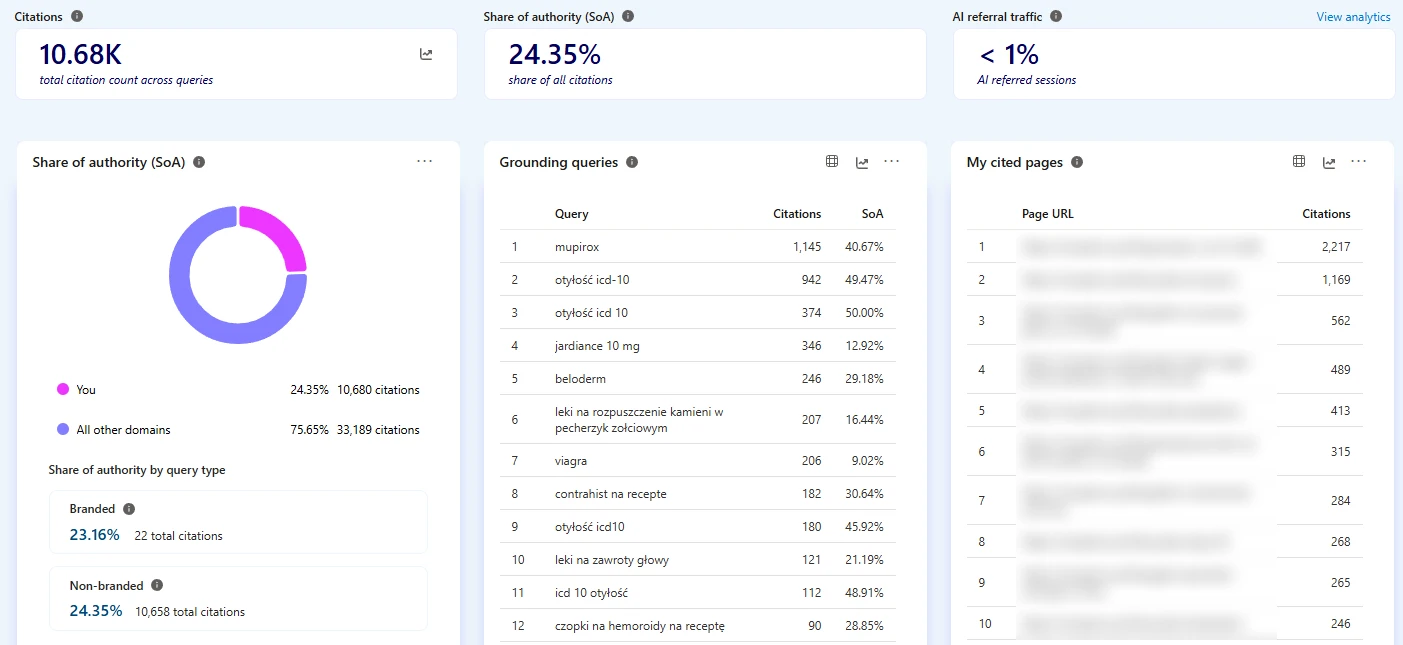
The report consists of five elements. The first three are the numbers at the top, the next two are tables, and the tables hold most of the work to be done.
How many times in the selected period pages from your domain served as a source in an AI answer. The basic measure of presence: it shows which content is cited regularly.
Your percentage share of the whole pool of citations for the same queries. A competitive metric, not a volume one, and with a catch in the way it is calculated, which gets its own section below.
The percentage of sessions that came from AI assistants, measured against all sessions in the period. It connects the citation layer with real traffic.
The queries the model used when retrieving content before it composed the answer. They are not the same as what the user typed, and that is the most interesting thing about them.
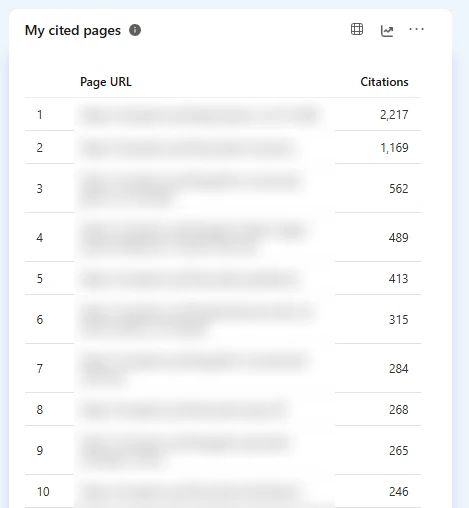
A list of your pages that made it into answers, with the number of citations and the related queries. This is where the list of content to expand comes from.
Grounding queries are not keywords
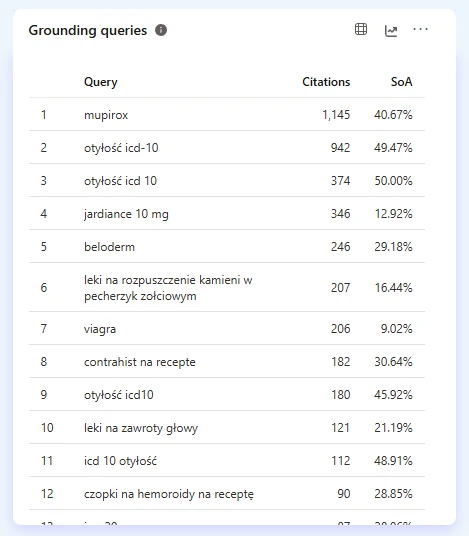
This table needs a separate explanation, because it is often misread. It displays the queries that the AI system used when retrieving content, not what a person typed. Microsoft says so directly: these queries may differ from the exact wording used by users.
The practical consequence is that you get a view of something entirely new: how the model categorises and searches for your content. A person asks at length and with context, the model turns that into its own concise wording. Matching content to the latter is a different job from classic keyword selection.
Cited pages
The "My cited pages" table is the one that produces a concrete to-do list. It shows the URLs of your pages, the number of citations and the related queries, so you know at once which content works and deserves expanding, and which appears rarely despite a good topic.
One caveat, which Microsoft gives in a footnote and which is easy to miss: the citation count says how often a page served as a source, not how prominently it was shown in the answer. You can be cited often and still be the third link in small print.
The "share of authority" trap
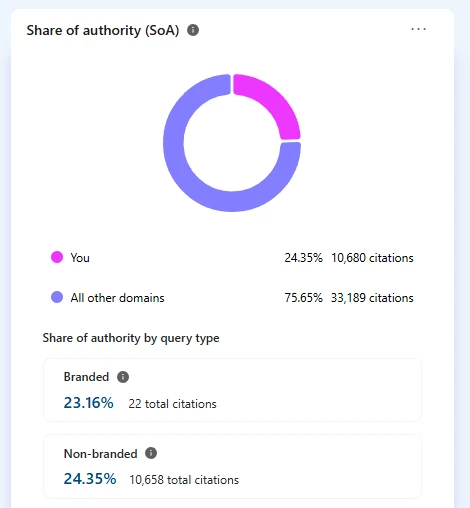
This is the metric that makes the biggest impression in a presentation, and at the same time the one from which it is easiest to draw an overly optimistic conclusion. The definition sounds simple: your percentage share of the whole pool of citations, that is your citations divided by the citations of all domains.
The catch sits in the way it is calculated, and Microsoft describes it in the documentation without beating about the bush. The calculation is done daily, but the pool includes only those days on which your domain was cited for a given query. Days on which the query was live and you were absent from the answers simply drop out of the sum.
What this means in practice
The metric measures your share on the days when you took part at all, not across the whole period. Microsoft describes this as a focus on active participation and adds that this way of calculating can produce higher values than a broader approach. In other words: twenty per cent in this report is not the same as twenty per cent presence in the answers.
How do you live with it? Treat the number as an indicator of trend, not of state. Comparing it month to month for the same domain makes sense, because the method of calculation is constant. Concluding from it that "we hold a fifth of the citation market in our industry" does not. For that second purpose, a better fit is to set the number of citations against the number of queries on which you appear at all.
A rare case of a vendor pointing out itself that its metric comes out more favourably than a full calculation would. It would be a pity not to read that far.
Assistant traffic as a separate channel
The second piece of the puzzle is not about citations but about real visits. Clarity separates assistant traffic into its own channel groups, so it stops getting lost in the "referral" bucket or, worse, in direct traffic.
AI Platform
Sessions of people who reached the site from an organic interaction with an assistant, that is from an answer, not from an ad.
Paid AI Platform
Sessions from paid formats inside AI platforms. A separate group, because the acquisition cost is entirely different.
The assistants recognised are ChatGPT, Copilot, Gemini, Claude and Perplexity. Separating them matters in practice, because these sources behave very differently, in both volume and quality of traffic. Thrown into one bucket, they give an average that tells you nothing.
Without channel groups
how it looks by default
Referrals
and direct traffic
everything in one bucket
an average that tells you nothing
With AI channel groups
the same traffic, a different split
AI Platform
visits from an assistant's answer
Paid AI Platform
visits from paid formats
each of the five sources counted separately
What Microsoft's data says
Microsoft has published a study based on data from Clarity itself, covering more than one thousand two hundred publishing and news sites. The numbers are telling enough to be worth knowing, with one important caveat that I come back to in a moment.
+155.6%
growth in AI traffic over eight months
+24.0%
growth in search traffic over the same period
<1%
share of AI in the total traffic of the sites studied
The most interesting part, however, is not about volume but about quality. The click-through rate to sign-up was 1.66% for traffic from language models, against 0.15% from search and 0.13% from direct visits. For subscriptions it was 1.34% against 0.55% from search. Referrals from Copilot converted to a subscription seventeen times better than direct traffic, and those from Perplexity seven times better.
The caveat without which these numbers mislead
The study covered publishing and news sites, and the conversions measured were sign-ups and subscriptions, not sales. Carrying these proportions straight over to an online shop or a service business would be a misuse. The direction is credible, the specific multipliers only for this category of sites.
The conclusion that survives being carried over to other industries is more cautious: assistant traffic is still marginal in volume, but it comes from people much closer to a decision than the average search user. That follows from the way such traffic arises: the model has already filtered out the options that do not fit before anyone clicked.
Clarity, Search Console and Bing: who shows what
Today we have three free sources of data on AI visibility and none of them replaces the others. They show different stretches of the same path.
Impressions in AI Overviews and AI Mode on the Google side. The largest scale, the least detail: no queries and no click-through rate. I take those reports apart separately.
Citations, Citation Share, intents and topics in the Microsoft ecosystem. The richest citation metrics. I have described them in detail.
Citations linked to traffic and to the behaviour of those users on the site. The only place where you see what the people who came from an assistant's answer actually do.
So Clarity's advantage does not lie in the citations themselves (Bing gives you more there) but in closing the loop. You know which query got you cited, how many people came in and whether they stayed. Neither of the other two tools can do that, because neither sees what happens once people are on your site.
How to use it
- 01Verify the domain today. Data is collected from the moment of verification, not retroactively. Even if you do not look at it for a month, the history will already be building.
- 02Start with the cited pages. The list of pages with citation counts tells you directly which content the model treats as a credible source. Those pages deserve expanding first.
- 03Review the grounding queries for gaps. Queries on which you appear rarely even though you have content on the topic are the most concrete to-do list you will get from this report.
- 04Set citations against traffic. High citations with negligible AI traffic mean that you are a source but nobody clicks. In that case you work on how the content gets summarised, not on whether it is visible.
- 05Look at the trend, not the value. Especially with share of authority. Month to month for the same domain: yes. As a picture of the market: no.
This whole layer rests on a foundation of content that can be cited. If the report sits empty, the problem is usually not the measurement but the fact that models have nothing to cite you for. I wrote about how to approach that when covering the BLUF method and citations in AI Overviews.
Measurement is only half the job
The report will show you where you stand. It will not tell you what to write to change that. The second part is what AI SEO deals with: a visibility audit, content written to be cited and regular measurement of whether citations are growing.
Limitations
- Citation data comes from Microsoft's infrastructure. Traffic reporting covers five assistants, but for citations themselves the picture is narrower than the whole AI market.
- One domain per project. In a project with several domains you pick one, and changing that choice after setup is not supported for now.
- No history from before verification. You start from zero on the day you connect. The later that is, the longer you wait for material to compare.
- Citation count is not prominence. The report does not say where you sat among the sources or how strongly your content shaped the answer.
- Niches can be empty. In a narrow or very local industry the report may show nothing for weeks. That is information about the market, not a defect.
None of these limitations undermines the point of the tool. What would undermine it is treating the report as a complete picture of AI visibility. It is one of three free views of the same problem, and that is how it is worth using.
FAQ: common questions
Is the Citations report in Clarity free?
Yes, entirely, like the rest of Clarity: no traffic limit and no paid plan. That is the most interesting part of this story: comparable data on citations in AI answers is sold today by subscription in tools such as Ahrefs Brand Radar or Semrush. Microsoft subsidises this access because it wants a place in the layer of AI visibility measurement before a market settles there. For you it means free access to data that you had to pay for a year ago.
What do I have to do to see citation data?
Verify ownership of the domain. Without it the tab stays empty. Clarity gives you three routes: installing the tracking code on the site, connecting through Google Search Console or connecting through Bing Webmaster Tools. With the last two you are redirected to the chosen platform, you sign in and pick the domain, and verification usually completes automatically. It is a one-off step per domain and it is done by the project admin.
How do grounding queries differ from ordinary keywords?
A grounding query is the query the model sent to a search engine to retrieve content before composing its answer, not what a person typed. The user asks conversationally, the model turns that into its own wording, often shorter and more technical. The value of this data lies in exactly that difference: it shows how the system understands and categorises your content, not how people phrase their questions. These are two different layers and both are worth knowing.
Does a high citation count mean I am prominent in the answer?
No, and Microsoft says so plainly in its documentation. The citation counter tells you how many times a page served as a source, not how prominent it was in the answer or where it sat among the sources. You can be cited often and still be the third link in small print under the answer. This matters for interpretation: being cited is a necessary condition of visibility, but it is not the same thing.
Will Clarity replace Search Console and Bing Webmaster Tools?
No. The three tools show three different pieces of the same picture and work best together. Search Console measures impressions in AI Overviews and AI Mode on the Google side. Bing Webmaster Tools gives you citations and Citation Share in the Microsoft ecosystem. Clarity adds something that exists nowhere else: the link between citations, real traffic and the behaviour of those users on the site. All three are free, so "which one should I choose" is the wrong question.
Does the data cover ChatGPT, or only Microsoft products?
Two things need to be separated. Traffic reporting covers a wide group: ChatGPT, Copilot, Gemini, Claude and Perplexity go into separate channels, so you see where visits really come from. The citation data itself, however, comes from the Microsoft infrastructure that handles grounding, and that has to be kept in mind in any comparison. The picture is therefore more complete on the traffic side than on the citation side.
I have several domains in one project. Does it work?
Partly. In a project that spans several domains you pick one for which you want to see citation data. The worse news is that changing that choice after setup is not supported for now, so make the decision deliberately rather than clicking to try it out. If you run several sites, a separate Clarity project for each is the simpler solution.
From what point does this data make sense?
From the moment it appears at all, and that depends on whether your content is cited in your niche. In niche or very local industries the report can sit empty for the first weeks, and that is not a fault of the tool but honest information about your situation. I would draw conclusions about a trend after two or three months, because only then do you see a direction rather than noise. The setup itself is still worth doing straight away, so that you have a reference point.
Worth remembering
- Citations in Clarity has been generally available since 13 May 2026 and costs nothing. Ahrefs Brand Radar or Semrush charge for comparable data.
- The prerequisite is domain verification: with the Clarity code, through Google Search Console or through Bing Webmaster Tools.
- "Share of authority" is calculated only from the days on which you were cited. Microsoft itself warns that this inflates the result compared with a broader calculation.
- Grounding queries are the queries the model used when retrieving content, not what a person typed. The two can differ a lot.
- The citation count says how often a page was a source. It does not say how prominently it was shown in the answer.
- AI traffic is still below 1% of visits, but in Microsoft's study it converted several times better than search traffic.
Summary
A year ago, measuring visibility in AI answers was the domain of expensive tools and guesswork. Today Microsoft gives it away for free, and the only cost of entry is a quarter of an hour to verify the domain.
You do not have to believe in it or forecast anything. You can simply check which questions already get you cited by AI.
Do one thing: verify the domain and come back to the report in a month. Even if you see nothing today, you will have a reference point, and that is more than most businesses in Poland have today.
Sources and further reading
The documentation and announcements on which I base the description of the reports and the data quoted:
- Microsoft Learn – Citation Dashboard Overview
- Microsoft Clarity Blog – Citations Now Generally Available
- Microsoft Clarity Blog – AI Traffic Converts at 3x the Rate of Other Channels (study)
- Microsoft Clarity Blog – Track AI Traffic & Optimize Conversions (AI channels)
- PPC Land – Microsoft Clarity gives away AI visibility tool rivals charge for
Want to be cited, not just to measure?
I will set up measurement in Clarity, Search Console and Bing Webmaster Tools, and then work on making the citations grow.
See AI SEOHow this text was written
I will not pretend it was written entirely by hand, by candlelight. For the research, the proofreading and the code of this page I used a language model. It is a good tool for digging through documentation and catching the typos you no longer see on the third read of your own text. The English version was also prepared with a model, from my Polish original.
What the model did not do: it did not choose the topic, form the arguments or decide what this data means for your site. That stays with me, as does the last word on what goes into the text and what comes out of it.
Where the model helped
- digging through sources and organising data
- proofreading and the English version of the text
- code, page layout and infographics
What stays with me
- the choice of topic and what is worth saying about it
- the arguments, the reading of the data and the conclusions
- fact-checking and the decision on what goes into the text

Written by
Sebastian Baryś
Freelance SEO specialist · Częstochowa, Poland, and remote
I started when nobody had dreamt of Core Web Vitals and rankings were checked by hand. Today I work on making companies visible not only in Google, but wherever people ask questions. I write only about things I check myself in client projects.